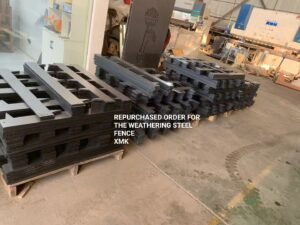
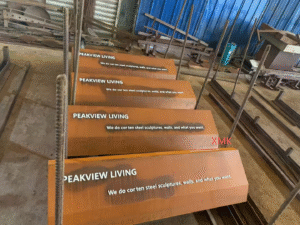
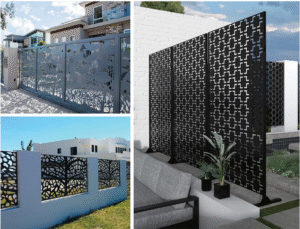
In the context of contemporary design, materials are no longer silent supporting roles, but have become the protagonists of spatial narratives. Weathering steel plates, a product of the industrial age, are reshaping our understanding of screens with their unique language. They are no longer partitions in the traditional sense, but spatial poets that carry the imprint of time, dialogue with nature, and warmth of humanity. When designers introduce this material with industrial genes into living spaces, a profound dialogue about rigidity and softness, eternity and change, and artificiality and nature quietly unfolds.
The art of weathering steel screens first shows a philosophical thinking of “rust aesthetics”. When this kind of steel is exposed to the natural environment, a stable rust-red oxide film will form on the surface, which will not only stop corroding, but also create a unique protective layer and visual effect. This characteristic of “rust-proofing” is just like the wisdom of “using softness to overcome hardness” in Eastern philosophy. In the courtyard of an art gallery in Hangzhou, a group of weathering steel screens, after three rainy seasons, present a gradient of rust from orange-brown to purple-brown, like a long scroll of ink painting created naturally. This appearance that changes over time breaks the limitations of traditional decorative materials that remain unchanged, making the screen a three-dimensional diary that records time. The designer cleverly turned this characteristic into an advantage, making every rust mark a natural brushstroke, and every color spot telling a story of encountering wind, rain and sunshine.
From a technical perspective, weathering steel screens demonstrate the exquisite balance of modern materials science. Compared to ordinary steel, alloy elements such as copper, chromium, and nickel are added to weathering steel to make its oxidation process controllable and stable. A weathering steel screen with a thickness of only 6mm can maintain structural integrity for more than 50 years without any coating protection, and its corrosion resistance is 4-8 times that of ordinary carbon steel. In a high-end residential project in Shanghai, the designer used laser cutting technology to carve fine traditional window lattice patterns on weathering steel plates. The thickness of the plate was precisely controlled at 3.2mm, which not only ensured the fineness of the hollow pattern, but also ensured the stability of the structure. This exploration of the limits of materials enables the screen to achieve visual lightness and transparency while meeting functional requirements, subverting people’s stereotypes of heavy and clumsy metal products.
The most attractive feature of the weathering steel screen is the dynamic dialogue it establishes with the natural environment. In a courtyard renovation project in Beijing, the designer placed the weathering steel screen in the transitional space between the courtyard and the interior. Its surface presents different color expressions with the change of seasons: dark reddish brown in the dry winter and bright orange-yellow in the rainy season. This change not only echoes the cycle of withering and flourishing of the plants in the courtyard, but also creates a symbiotic relationship between “artificial” and “natural”. The wind makes a subtle metal resonance when it passes through the hollow space of the screen, raindrops leave unique water marks on the rusted surface, and the sun shines through the holes to cast a constantly moving light and shadow pattern on the ground – the weathering steel screen has become a medium for recording the rhythm of nature, allowing residents to perceive those often overlooked microscopic natural phenomena.
At the level of spatial narrative, weathering steel screens demonstrate amazing expressiveness and adaptability. In a creative office space in Shenzhen, a set of rotatable weathering steel screens serves as both a regional divider and a display carrier for the company’s history. By controlling the degree of oxidation on the screen surface, different depths of time are formed, which metaphorically represent the different stages of the company’s development; the laser-engraved corporate milestones are looming on the rusty background, creating a sense of historical heaviness. In a teahouse in Chengdu, the designer combined weathering steel plates with traditional bamboo weaving techniques, embedding flexible bamboo strips in the rigid steel frame, and in the material contrast, alluding to the spiritual core of the Bashu culture of both rigidity and flexibility. This cross-material and cross-cultural fusion experiment expands the possibility of screens as cultural carriers.
From the perspective of practical functions, weathering steel screens solve many pain points of traditional partition materials. Compared with wooden screens, they are not afraid of moisture and termites; compared with glass partitions, they are more private and artistic; compared with ordinary metal screens, they eliminate the maintenance cost of regular painting. A seaside restaurant in Guangzhou uses weathering steel screens as windbreaks for outdoor dining areas. After five years of sea breeze and salt spray, they are not only functional, but also become the restaurant’s iconic landscape due to their special rust texture. This characteristic of “the more you use it, the more delicious it is” is highly consistent with the current sustainable design concept, which greatly extends the product life cycle.
Contemporary designers are constantly expanding the expression of weathering steel screens. Some combine steel plates with LED lighting, turning rusty holes into a canvas for light and shadow art; some use parametric design to create a three-dimensional screen structure with bionic forms; others try to introduce biological elements such as moss on the surface of steel plates to accelerate the formation of an ecological symbiotic system. These innovations not only enrich the visual effect of the space, but also transform the screen from a static object into an intelligent interface that can interact with users.
The popularity of weathering steel screens reflects the complex emotional needs of contemporary people: looking for natural traces in industrial civilization, longing for eternal witness in rapid changes, and craving for real touch in digital virtuality. Its rusty surface that changes with time seems to remind us that true beauty lies not in resisting the passage of time, but in recording the footprints of time. When a beam of sunset shines obliquely on the mottled steel screen, casting a fine pattern of light and shadow, we suddenly understand: this is no longer a simple piece of furniture, but a time and space traveler who writes poetry with steel, telling a dialectical allegory about change and permanence in silence.
Contact:
WA+86 17366692145 Email: qihengtrkrystal@gmail.com